In short
|

Fair condition Belah semi-arid woodland in eastern Murray-Sunset.
Semi‑arid Woodlands in the Victorian Mallee
Semi‑arid woodlands were once widespread across the Victorian Mallee but have been greatly reduced by clearing, with most remaining areas now confined to conservation reserves. These woodlands are characterised by tree species such as Buloke (Allocasuarina luehmannii), Belah (Casuarina pauper), Slender Cypress Pine (Callitris gracilis) and Sugarwood (Myoporum platycarpum), a sparse shrub layer (for example Cattle Bush, Weeping Pittosporum, Wattles and Hakeas) and groundcover of herbs, saltbush and grasses.
Buloke-dominated woodland communities are particularly depleted and are listed as threatened under Federal and Victorian legislation. Remaining semi-arid woodlands (on both private and public land) face ongoing pressures from incremental clearing, grazing (by rabbits, goats and kangaroos), bushfire and weed invasion. These pressures impede the already slow natural regeneration of key tree species. Woodland condition varies, with healthier sites retaining intact canopies, shrub layers and diverse ground cover, while degraded sites lack these features.
What we are doing
Since 2012, ARI has partnered with Parks Victoria to monitor the condition of semi-arid woodlands across key conservation areas in north-west Victoria. These include Murray-Sunset, Hattah-Kulkyne and Wyperfeld national parks, as well as Lake Albacutya Park and the Yarrara, Mallanbool, Dunstans, Dering and Turriff Flora and Fauna Reserves.
The program is helping Parks Victoria to evaluate their grazing management plan, which aims to reduce grazing impacts on native vegetation and revegetated areas. The program is studying tree population dynamics (age, size, regeneration), understorey vegetation (abundance of small trees, shrubs and ground layer plants) and grazing pressure.
Each year, 60 sites were assessed as part of a five‑year rotating program, with 300 sites established in total; 240 (48 sites per year) are still actively monitored today.
This research is helping us to increase our understanding of woodland ecology and assess the effectiveness of management actions in improving woodland condition. Our research is directly supporting Parks Victoria in refining management actions to recover this threatened ecosystem.
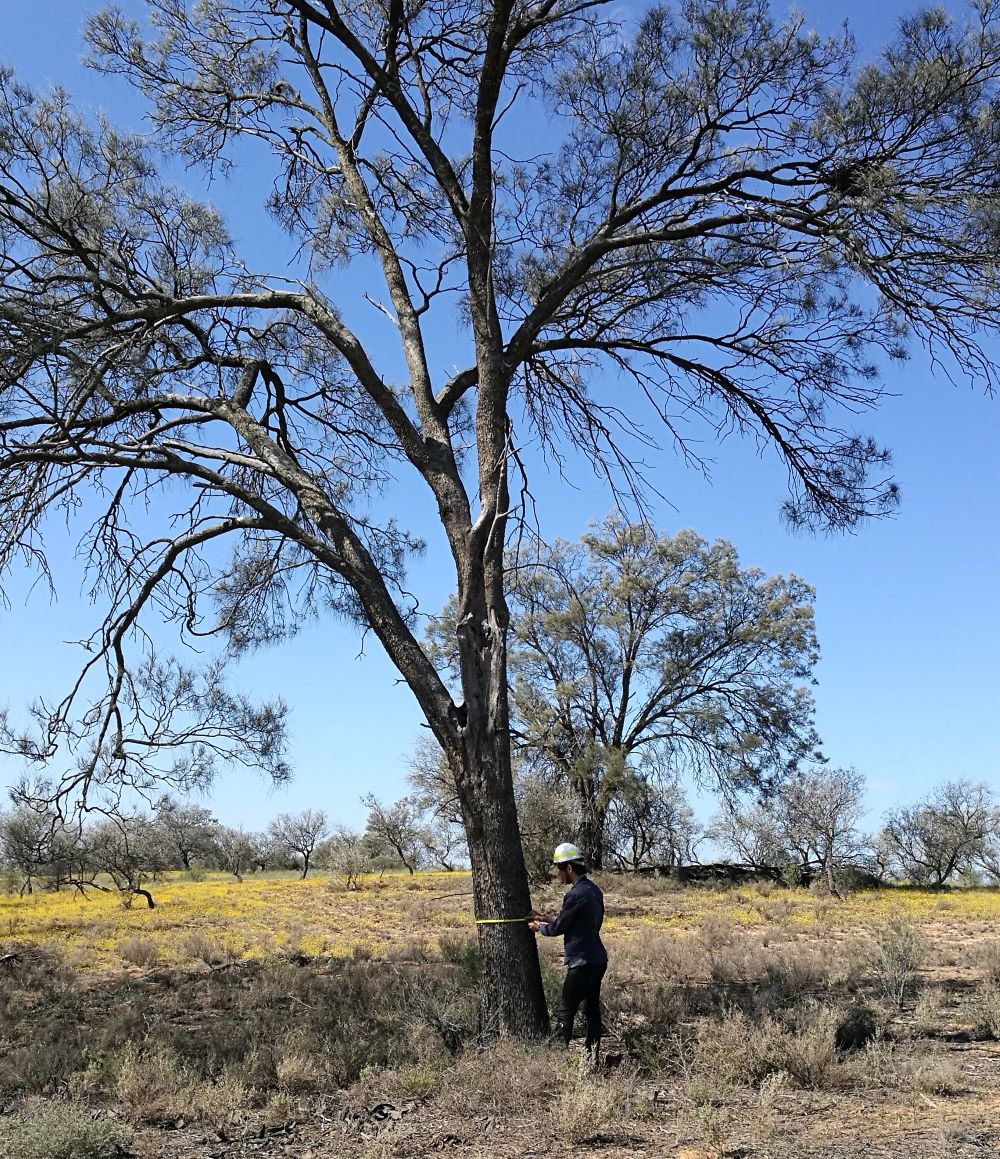
Monitoring tree diameter in southern Murray-Sunset National Park
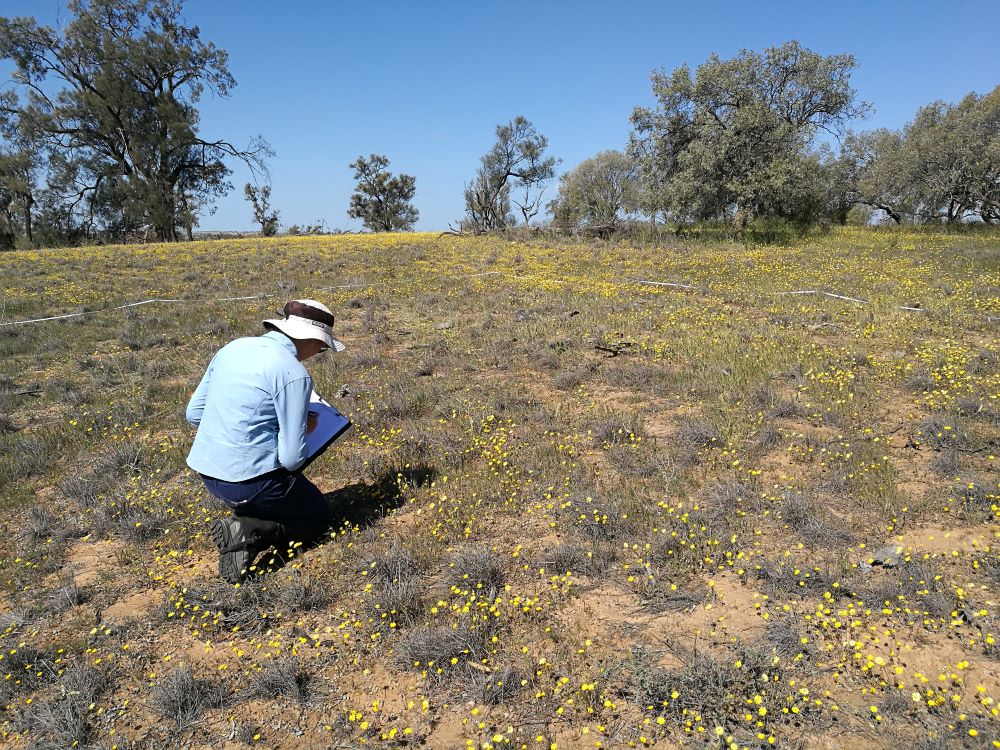
Monitoring ground cover in southern Murray-Sunset National Park.
Key findings
Our research has found:
- Ongoing browser control is important and has been effective in supporting the recovery of grazing-sensitive, slow-growing Semi-arid Woodlands.
- Woodland condition at some sites has improved through increased natural recruitment, large shrub and native plant richness.
- Some sites where natural recruitment is still limited despite browsing control, additional interventions such as revegetation may be required to improve woodland condition.
- Most woodlands are not self-sustaining, requiring ongoing browser control, fire prevention and targeted revegetation to support their long-term survival.

Belah semi-arid woodland in fair condition at Dunstan’s Flora and Fauna Reserve.
Acknowledgements
This project is funded by Parks Victoria and DEECA. The initial stages of the monitoring program were also supported by funding from the Mallee Catchment Management Authority.
Publications
- Annual Monitoring southern Murray-Sunset and southern Wyperfeld- April 2026 Update- Victorian Semi-arid Woodlands (PDF, 1.2 MB) (DOCX, 4.3 MB)
- Annual monitoring: Hattah-Kulkyne & eastern Murray-Sunset May 2025 Update -Victorian semi-arid woodlands factsheet (accessible version (DOCX, 22.0 MB))
- Total grazing management plan progress - January 2025 Update - Victorian semi-arid woodlands fact sheet (PDF, 1.3 MB) (accessible version (DOCX, 10.6 MB))
- Vegetation change at monitoring sites-January 2025 Update - Victorian semi-arid woodlands fact sheet (PDF, 631.7 KB) (accessible version (DOCX, 2.8 MB))
- Defining vegetation condition-2025-Victorian semi-arid woodlands fact sheet (PDF, 943.3 KB) (accessible version (DOCX, 3.0 MB))
- Kenny, S.A. and Moxham C. (2022) Does above average rainfall stimulate a recruitment pulse in semi-arid woodlands of southeastern Australia? Journal of Vegetation Science 3(5): e13148
- Cheal, D., Moxham, C., Kenny, S. and Millet-Riley, J. (2013) Rare plant recovery in Mallee woodlands. Victorian Naturalist 130(3): 96-108
For more information contact Sally Kenny (sally.kenny@deeca.vic.gov.au) or Claire Moxham (claire.moxham@deeca.vic.gov.au).
Page last updated: 29/05/26