In short
|
Environmental water in Victoria
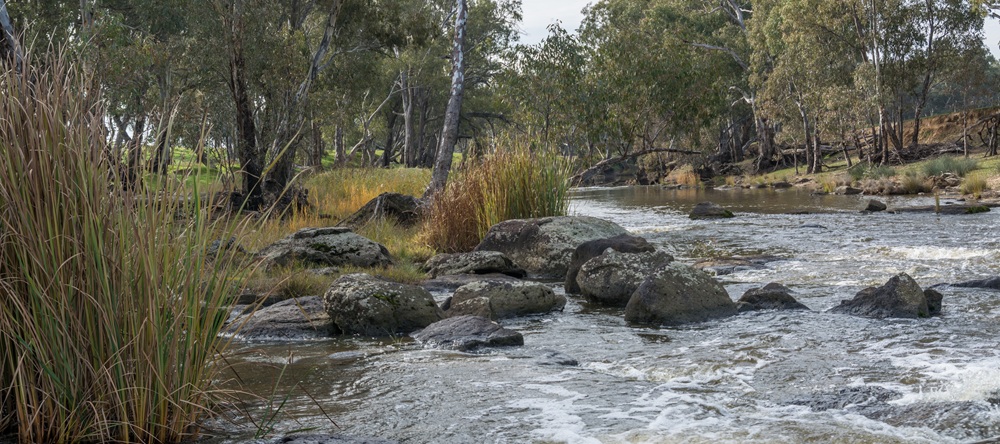
Water for the environment, also known as 'environmental water', is water released into regulated rivers, floodplains, wetlands and estuaries to improve waterway health and protect environmental values.
The development and implementation of Victoria’s environmental watering program is a collaborative process between Victorian and Commonwealth government agencies, including land managers and water corporations. Understanding how to maximise the benefits of environmental watering requires ecological data and underpins the decision-making processes of these programs.
Getting the most of environmental water
To make the most of environmental water delivery for both plants and animals, we need to restore key aspects of the flow regime that are linked to the processes that govern population dynamics. Much of our environmental flow monitoring and research focuses on understanding key population processes (for example, reproduction, mortality, movement and dispersal) and how these are influenced by:
- life history processes (for example, survival of offspring, growth)
- intrinsic factors related to a species (for example, reproductive rate, behaviour, genetics, longevity)
- extrinsic factors related to the environment (for example, river flows, temperature, predation, habitat connectivity)
- correlated or confounding factors (for example, rainfall, grazing, introduced species, geomorphology, fish stocking).
What we are doing
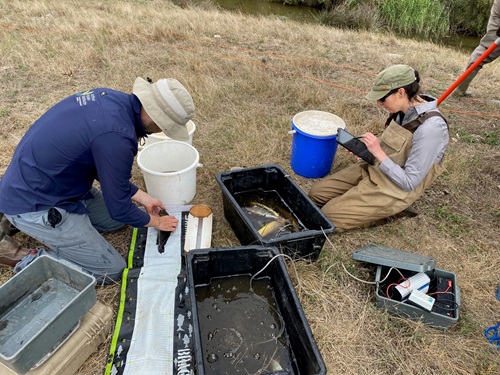
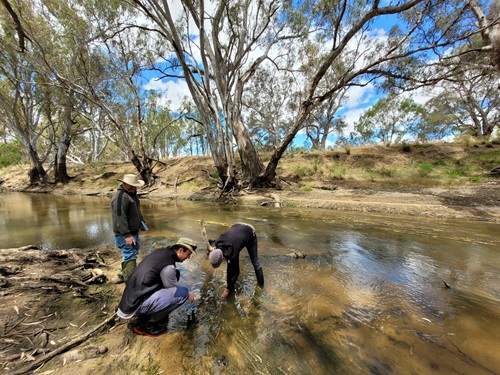
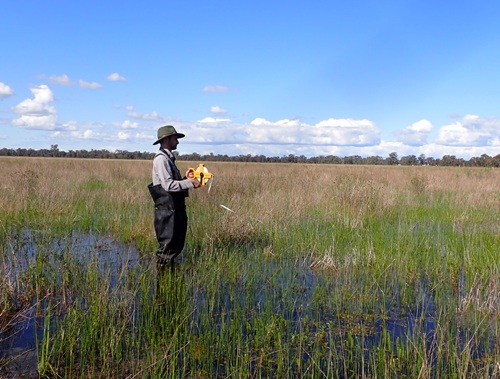
ARI has extensive experience in monitoring and research supporting Victoria’s environmental water management, ranging from local sites to large-scale landscapes across rivers, floodplains, and wetlands. This work spans multiple ecological groups, including fish, vegetation, waterbirds, woodland birds, frogs, and turtles.
Our science aims to:
- fill knowledge gaps to improve planning, delivery and evaluation of environmental water management in rivers and wetlands
- contribute to Victorian Government’s reporting obligations under the Murray-Darling Basin Plan
- demonstrate the outcomes of environmental water use in rivers and wetlands.
To do this, we use a range of techniques including field surveys, nursery and research trials, animal tagging and tracking, a variety of modelling approaches, genetic and microchemistry analyses, literature reviews, long-term trend analyses and expert elicitation.
Key features of our work include bringing long-term, large data sets together to enhance opportunities for rigorous analysis and considering the importance of complementary measures in water management.
To date, our work has greatly improved the sampling methods, analysis approaches, understanding of management effectiveness, improved management actions implemented by managers and provided substantial evidence of outcomes.
ARI is involved in several large state and national programs related to environmental water management.
Statewide Programs
The Victorian Government established the Victorian Environmental Flows Monitoring and Assessment Program (VEFMAP) in 2005. The program aimed to assess ecosystem responses to changes in flow regime in regulated Victorian rivers that receive environmental water. It was undertaken in a series of stages and concluded in 2024. ARI led the delivery of VEFMAP from 2015 to 2024, with a focus on fish and vegetation.
The Victorian Government established the Wetland Monitoring and Assessment Program for environmental water (WetMAP) in 2014. The program aimed to understand the response of wetland vegetation and a range of fauna to the delivery of environmental water. It was undertaken in a series of stages and concluded in 2024. ARI led the delivery of WetMAP from 2015 to 2024, with a focus on vegetation, waterbirds and fish.
This program replaced VEFMAP and WetMAP in 2025 and is led by DEECA Water and Catchments Group. The program aims to assess and understand the ecological outcomes of environmental watering, so water can be delivered more effectively to improve the health of rivers, wetlands and floodplains.
ARI is delivering projects which align with DEECA and catchment management authority priorities for environmental water planning and delivery. This includes annual fish monitoring, data management, a review of low flow impacts on water quality and fish populations, and a review of how project methods align with other programs.
The Victorian Murray Floodplain Restoration Project (VMFRP) aims to restore ecologically significant wetlands and floodplains at sites along the Victorian Murray River floodplain. This project is part of the Sustainable Diversion Limit program of the Murray-Darling Basin Plan. It will involve building infrastructure including levees, regulators, pipes and pumps to deliver water to selected areas in the mallee and north central regions of Victoria.
In 2021, ARI led the development of the Ecological Monitoring, Evaluation and Reporting (MER) Plan, which is central to the project. ARI is also involved in undertaking ecological monitoring in the mallee for vegetation, fish, birds and frogs.
Commonwealth Programs
The Living Murray Program (TLM) is a long-running river restoration program within the Murray-Darling Basin which began in 2002. Across eight Icon sites, monitoring includes:
- Condition monitoring – assesses the ecological health of sites annually and reports on progress against objectives and targets in Environmental Water Management Plans.
- Intervention monitoring – conducts research and evaluation to assess responses to ecological interventions, monitors associated risks and compliance with statutory obligations.
Themes monitored include vegetation, fish, crayfish, turtles, waterbirds and woodland birds. TLM is a joint initiative funded by the New South Wales (NSW), Victorian, South Australian, Australian Capital Territory and Australian governments, coordinated by the Murray–Darling Basin Authority.
ARI is taking a lead role in bringing TLM data together, including creating a database that will support rigorous analysis and synthesis of this long-term data set.
ARI has been involved in monitoring and research to fill important knowledge gaps and evaluate intervention outcomes specific to Icon Site needs. This includes the Hattah Lakes and Lindsay-Mulcra-Wallpolla, Barmah-Millewa, Gunbower Forest and Koondrook-Perricoota Forest Icon Sites. Monitoring reports for Icon Sites are available at the Living Murray Program website.
Flow-MER is the Commonwealth Environmental Water Holder’s science program, working in partnership with scientists, water managers and communities across the Murray–Darling Basin. This program aims to understand how rivers, wetlands, floodplains, and their plants and animals respond to Commonwealth environmental water.
ARI has been involved in this program and its predecessor, the Long-Term Intervention Monitoring (LTIM) program, for many years.
ARI is involved in the:
- Area-scale Project which conducts targeted monitoring and research in 10 river systems (called Areas) within the Basin to understand local ecosystem responses and inform water management practices. The data is also used to help inform Basin-Scale Evaluation.
ARI monitors the Goulburn River and northern Victorian tributaries to determine annual trends in fish abundance and species diversity, and annual and seasonal trends in the cover and species diversity of bank vegetation. The Area-scale Project has also supported research projects including movement tracking of Brolga and a review of how river channels support waterbirds.
- Basin-scale Project which evaluates the outcomes of Commonwealth environmental water across the basin; reports against Basin objectives and the Basin-Wide Environmental Watering Strategy expected environmental outcomes; studies how ecosystems respond to environmental water; and manages data and shares what has been learnt.
There are five themes including the:
- Native fish theme – ARI provides leadership and guidance to the Fish Working Group, reviews reports and analyses and leads the theme Basin-scale evaluation.
- Native Vegetation theme – ARI contributes to the review of the evaluation plan and Basin-scale report.
Flow MER Publications
- Hladyz et al. (2025) Basin-scale evaluation of the 2023-24 Commonwealth environmental water: Fish. Flow-MER Program.
- Todd et al. (2023). Fish population models to inform Commonwealth water for the environment. Flow-MER Program
- Todd et al. (2024), Fish population models: Sensitivity to key life history characteristics in the Murray cod and golden perch population models. Research report. Flow-MER Program.
- Thiem et al. (2023). Regional and inter-regional fish movement responses to river discharge to inform Commonwealth water for the environment. Flow-MER Program.
 |  |  |
How we can help
ARI offers expert advice to support the effective management of environmental water to benefit native animals, plants and communities. This includes:
- providing advice on appropriate monitoring and research to demonstrate the outcomes of environmental water use
- contributing to seasonal watering plans and Environmental Watering Management Plans
- identifying key knowledge gaps to improve the planning, delivery and evaluation of environmental water management
- supporting Victoria’s reporting obligations under the Murray-Darling Basin Plan
- collating and reviewing extensive datasets and using innovative techniques to ensure rigorous scientific analyses.
Publications
You can find reports and articles related to each long-term program on their associated webpages.
Additional research that ARI has led, or been involved in, related to environmental water include:
- Amtstaetter et al. (2016). Environmental flow releases trigger spawning migrations by Australian grayling Prototroctes maraena, a threatened, diadromous fish. Aquatic Conservation: Marine and Freshwater Ecosystems.
- Amtstaetter et al. (2015). Improving our ability to collect eggs of the threatened Australian grayling, Prototroctes maraena. Marine and Freshwater Research 66: 1216-1219.
- Hansen (2019). Livestock grazing effects on riparian bird breeding behaviour in agricultural landscapes. Agriculture, Ecosystems and Environment.
- Higgisson et al. (2025). Integrating drone and deep learning technology to monitor floodplain changes in response to environmental flows. Hydrobiologia.
- Koehn et al. (2019). Fish and flow management in the Murray-Darling Basin: Directions for research. Ecological Management and Restoration.
- Koster et al. (2017). Predicting the influence of streamflow on migration and spawning of a threatened diadromous fish, the Australian Grayling Prototroctes maraena. Environmental Management.
- Koster et al. (2016). Provision of environmental flows promotes spawning of a nationally threatened diadromous fish. Marine and Freshwater Research.
- Koster et al. (2014). Timing, frequency and environmental conditions associated with mainstem–tributary movement by a lowland river fish, golden perch (Macquaria ambigua). PloS one.
- Koster et al. (2013). Downstream spawning migration by the amphidromous Australian grayling (Prototroctes maraena) in a coastal river in south-eastern Australia. Marine and Freshwater Research.
- Koster et al. (2024). Factors influencing migration of short‐finned eels (Anguilla australis) over 3 years from a wetland system, Lake Condah, south‐east Australia, downstream to the sea. Journal of Fish Biology.
- Koster et al. (2023). Downstream migration of telemetry-tagged adult common galaxias (Galaxias maculatus) in a coastal river system. Marine and Freshwater Research.
- Tonkin et al. (2017) Flow magnitude and variability influence growth of two freshwater fish species in a large regulated floodplain river. Hydrobiologia.
- Shanafield et al. (2024). Australian non-perennial rivers: Global lessons and research opportunities. Journal of Hydrology.
- Stoessel et al. (2023). Assessing the use of environmental flows and stocking for the persistence of a flow-dependent spawner in a drying climate. Marine and Freshwater Research.
- Stuart, I. et al. (2019). From an irrigation system to an ecological asset: adding environmental flows establishes recovery of a threatened fish species. Marine and Freshwater Research.
- Tonkin et al. (2017). Flow magnitude and variability influence growth of two freshwater fish species in a large regulated floodplain river. Hydrobiologia.
- Tonkin et al. (2019). Hydrology and water temperature influence recruitment dynamics of the threatened silver perch Bidyanus bidyanus in a regulated lowland river. Marine and Freshwater Research.
Page last updated: 15/09/26