In short
|
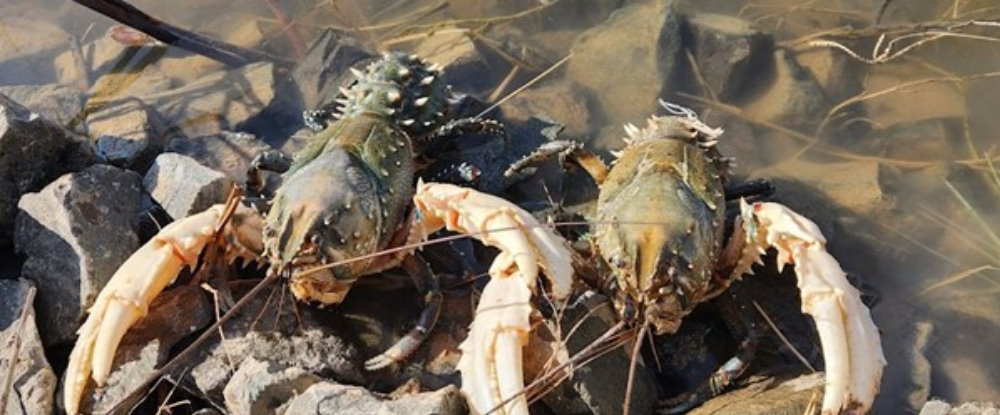
Murray Spiny Crayfish - photo by Scott Raymond
A threatened, keystone species
The Murray Spiny Crayfish (Euastacus armatus) is the second largest freshwater crayfish species globally. Numbers have been declining since the 1950s. In 2025, the species was nationally listed as Vulnerable under the Environment Protection and Biodiversity Conservation Act 1999 and it is currently listed as threatened in Victoria under the Flora and Fauna Guarantee Act 1988.
Found along the Murray River and its tributaries, the Murray Spiny Crayfish
- is long lived (25+ years)
- is very slow growing (sexually mature at 5-7 years)
- has a small home range (about 100m)
- has limited mobility and reproductive output
These characteristics make it particularly vulnerable to threats including habitat degradation and pollution, poor water quality from hypoxic blackwater events (when dissolved oxygen levels reach critically low levels), and overharvesting.
The species is highly valued by Traditional Owners, conservationists and recreational fishers. It is a keystone species, meaning it plays a crucial role within the ecosystem, through processing organic matter, providing food for other aquatic animals and modifying the physical environment through burrowing and moving around.
What we are doing
Our research is investigating key characteristics of the species’ biology and threats, to better inform the management and recovery of the Murray Spiny Crayfish.
Through several research projects, ARI is monitoring populations along the Murray River and its tributaries in Victoria including the Mitta Mitta, Kiewa, Ovens and Goulburn rivers. This work is helping us gather important population data such as sex, size and presence of eggs.
We are evaluating:
- blackwater events and harvest pressure
- the effectiveness of reproductive indicators used to guide fishing regulations
- impacts of egg loss due to angler handling
- how different population structures may influence population trends.
Monitoring and Research examples
Murray Spiny Crayfish is vulnerable to overfishing and ‘blackwater’ events during flooding which result in extremely low levels of oxygen in the water. Fisheries regulations for Murray Spiny Crayfish, to help counterbalance the possible effects of overharvesting, include:
- a restricted harvest season
- closures for regions
- a bag limit
- a harvestable length limit and
- a ban on possessing egg bearing females.
The risk of harvest pressure and blackwater events was examined using population modelling. This research found that blackwater events result in increasingly frequent population loss of Murray Spiny Crayfish. Populations that undergo catastrophic population decline will be further impacted when high levels of harvest pressure are also present.
The 2013 change to legal harvesting which limits to a ‘slot size’ in occipital carapace (hard shell) length of 10-12cm was also tested by the model, which indicated that this had been a suitable protection measure, as more females are expected to be protected.
These findings help us better understand the viability of this species in the face of threats and can guide conservation actions.
To find out more about population modelling of Murray Spiny Crayfish, visit Population models to inform fish and waterway management and our Murray Spiny Crayfish population model fact sheet.
Publication: Todd, C. et al. (2018). Integrating Fishing and Conservation in a Risk Framework: A Stochastic Population Model to Guide the Proactive Management of a Threatened Freshwater Crayfish. Aquatic Conservation: Marine and Freshwater Ecosystems, 28(4), 954-968.
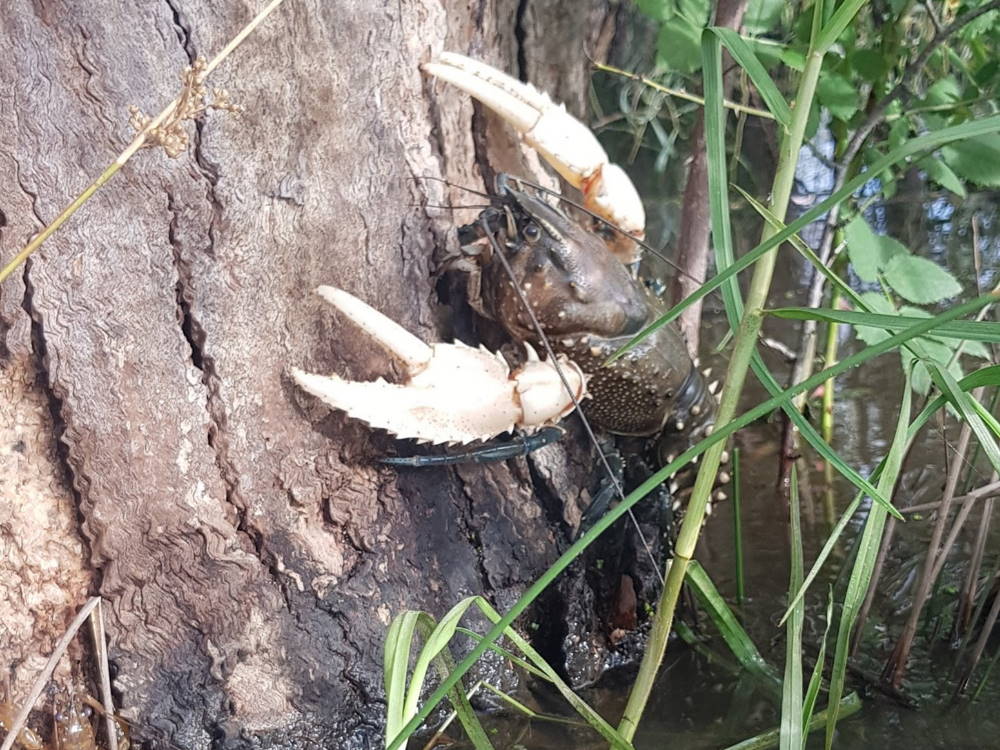
A Murray Spiny Crayfish climbing out of water during a blackwater event.
Recreational harvesting of Murray Spiny Crayfish is managed using size and sex-specific regulations. These regulations aim to protect reproductively active females that are crucial to the population survival. Reproductive state in females is measured using the size at onset maturity (SOM) as an indicator.
ARI conducted a comparative study of SOM and another indicator, size at functional reproduction (SFR), which is based on the relationship between the size of a female and the likelihood of the presence of eggs. ARI investigated how accurately each indicator measured sexual maturity and found that SFR provided a more biologically accurate measure.
This finding helps us understand how different reproductive indicators can be used to guide management of recreational harvesting of Murray Spiny Crayfish.
To find out more about reproductive indicators for Murray Spiny Crayfish, visit Population models to inform fish and waterway management.
Publication: Raymond, S.M., and Todd, C. R. (2020). . Assessing risks to threatened crayfish populations from sex-based harvesting and differential encounter rates: A new indicator for reproductive state. Ecological Indicators,118.
Murray Spiny Crayfish eggs are carried underneath their tail; if these eggs become dislodged, the eggs can die which likely contributes to population decline. Unintended egg loss can occur when anglers are checking if an individual crayfish is carrying eggs, to comply with regulations. The use of techniques like tail unfurling can disturb the crayfish, triggering muscle contractions that can detach up to 40 eggs each time it is handled. This is significant since Murray Spiny Crayfish tend to carry between 300 and 1500 eggs.
ARI investigated the impact of egg loss from fisher handling on population-level decline. By combining population modelling and field data, ARI found that populations faced greater risk of extinction when egg loss and harvest pressure, were high.
This finding shows the importance of community education in helping protect the future of Murray Spiny Crayfish in our waterways. Building awareness amongst fishers of how non-invasive methods can be used to check the sex and reproductive maturity of Murray Spiny Crayfish can help reduce egg loss.
Males have their sex organs (papillae) on the fifth pair of legs, whilst females sex organs (gonopores) are on the third pair of legs. If the female gonopores have hairs, she likely has eggs.
Publication: Raymond, S. M. et al. (2024). Understanding the effects of egg loss from fisher handling to improve conservation of a threatened freshwater crayfish (Euastacus armatus). Marine and Freshwater Research, 75(7).
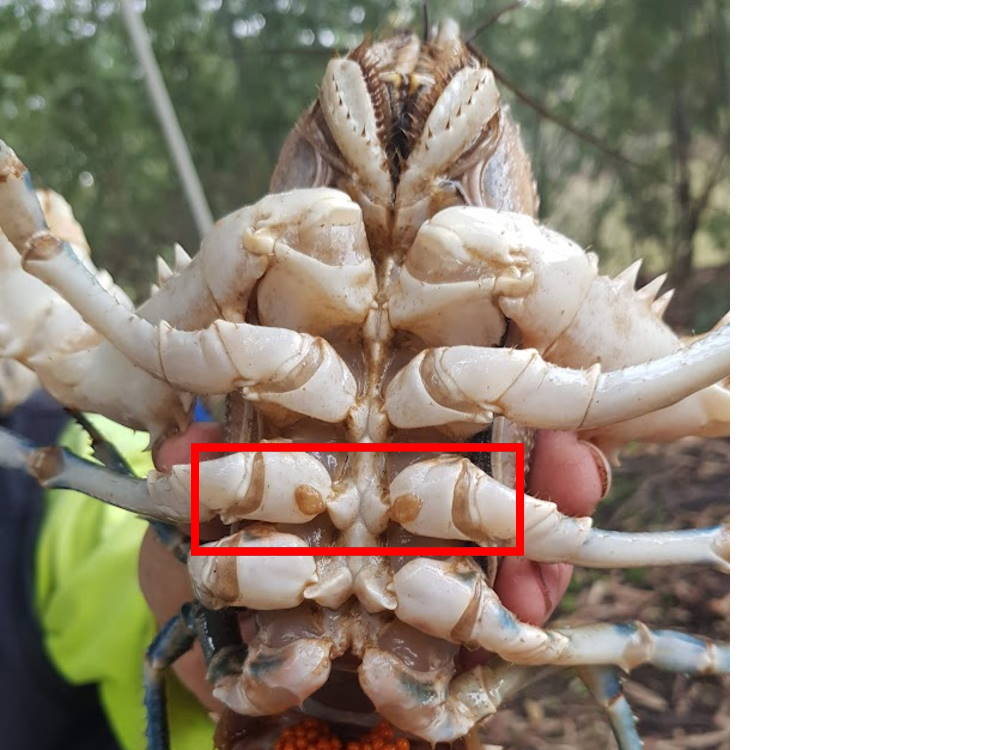
A female Murray Spiny Crayfish, identified by the location of sex organs (gonopores) on the third pair of legs - photo by Scott Raymond
Monitoring populations, including recording sex ratios, size structures, density estimates, and movement patterns can provide useful information to understand population trends of Murray Spiny Crayfish over time. ARI analysed changes in these indexes between 2017 and 2020, using data from sites within the Barmah-Millewa National Park.
Key findings include:
- The Murray Spiny Crayfish population experienced an overall decrease in density between 2017 and 2020.
- Sex ratios remained unequal between 2017 and 2020, with more females present.
- Female crayfish size structures became increasingly biased towards larger individuals.
- Size structures for males became increasingly biased towards smaller individuals.
Reduced density estimates and unequal sex ratios and size structures indicate that the Murray Spiny Crayfish is still under threat from harvesting pressure.
These findings can be used to guide decision-making on managing risks faced by the species.
Publication: Raymond, S. M. (2023). Using density estimates, sex rations and size structure to assess the status of a threatened Australian freshwater crayfish (Euastacus armatus population. Hydrobiologia, 850(19), 4181–4194.
You can learn more about how we collect population data through our video ‘Murray Crayfish surveys – protecting the world’s second largest crayfish’.
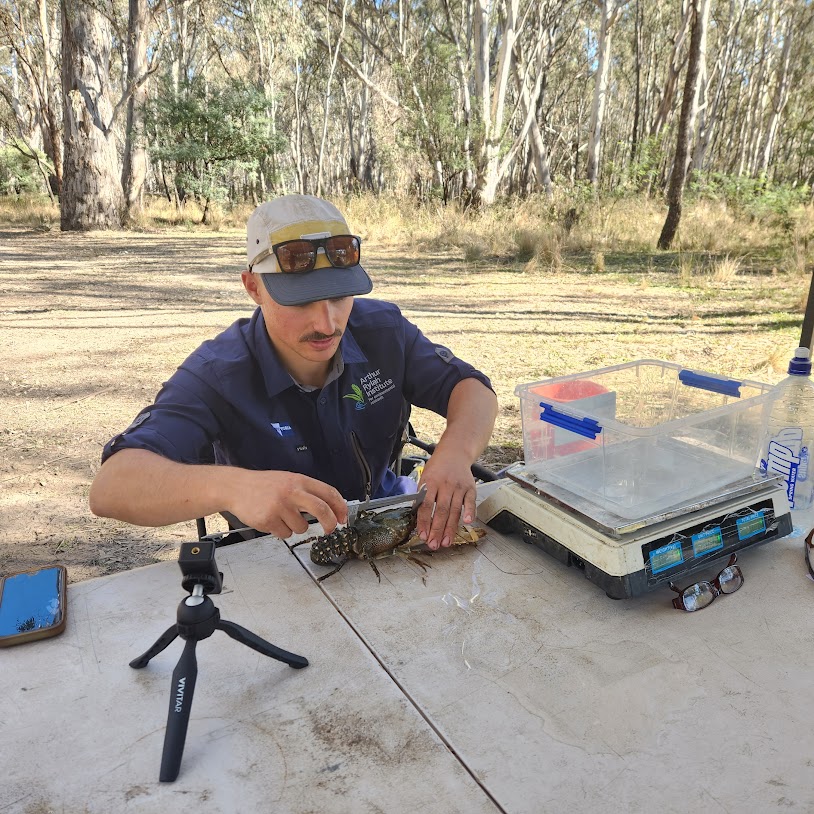
Measuring a Murray Spiny Crayfish - photo by Scott Raymond
Following major flooding and blackwater impacts in the Little Murray River, a conservation translocation was undertaken to re-establish Murray Spiny Crayfish in this important anabranch of the Murray River. This trial translocation was delivered as a collaboration between ARI, the North Central Catchment Management Authority, and the Wamba Wamba, Yorta Yorta and Barapa Barapa Traditional Owners.
The project identified and assessed potential release sites within the Little Murray River, selecting a reach at Fish Point based on habitat quality, flow conditions and restoration works already undertaken in the system. Surveys confirmed Murray Spiny Crayfish were absent from the selected reach before translocation.
In May 2025, 100 adult Murray Crayfish (51 females carrying eggs and 49 males) were captured from the Stuart Murray Canal, PIT-tagged and released into the Little Murray River. Four months later, monitoring surveys recaptured 13 translocated crayfish, confirming their short-term survival, continued growth and high egg retention by females. The project also developed a collaborative translocation framework that integrates Traditional Owner knowledge, ecological science and waterway management to guide future recovery efforts for this threatened species.
Publication: Raymond, S. M. et al. (2026). Translocating adult Murray Crayfish Euastacus armatus from an artificial canal to the Little Murray River. ARI Report for North Central Catchment Management Authority.
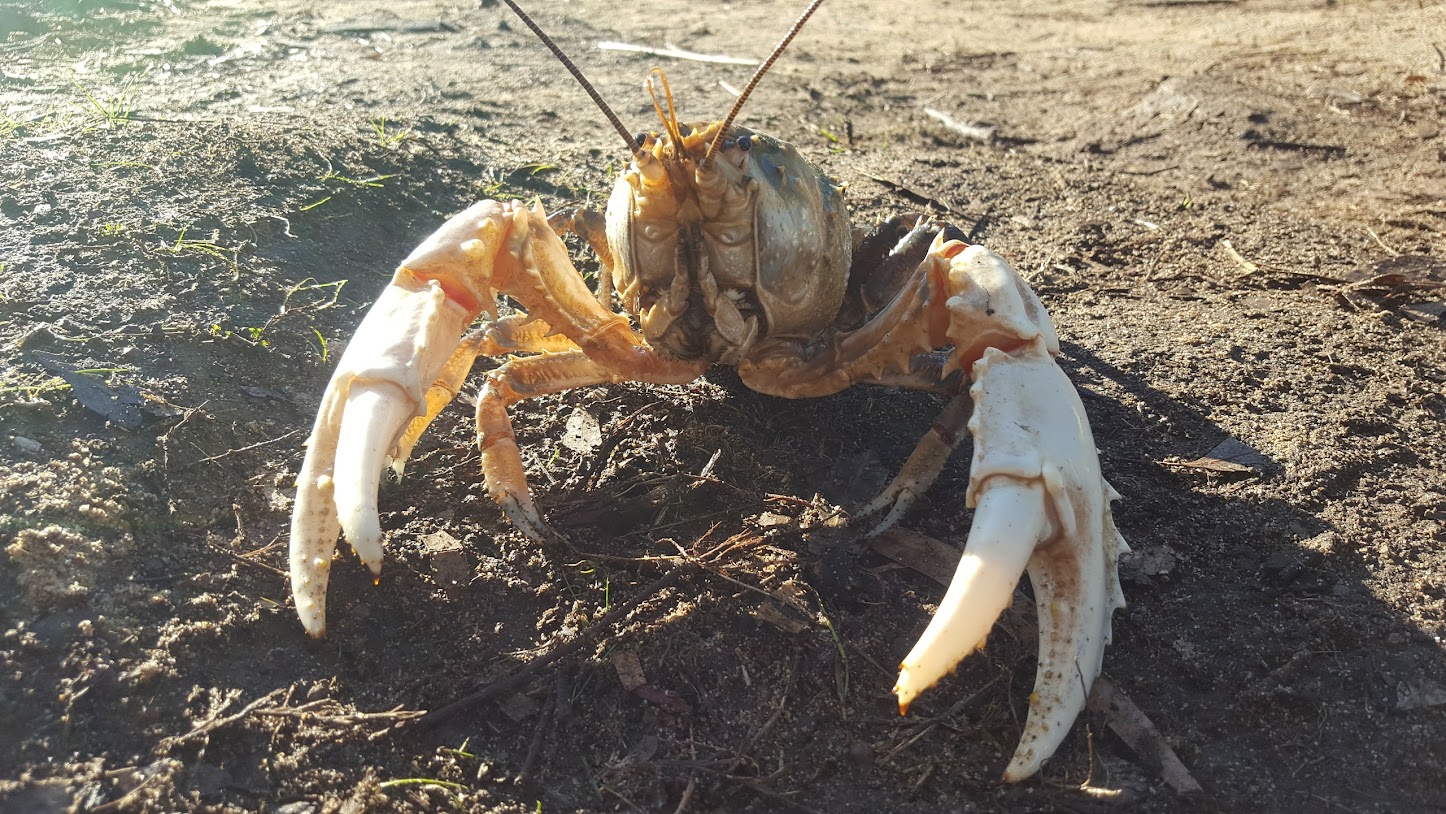
An adult Murray Spiny Crayfish. Photo by ARI.
How you can help
To protect Murray Spiny Crayfish and ensure future generations can continue to catch them, you can help by:
- Following Victorian Fishing Regulations, regarding minimum and maximum legal size, bag and possession limits.
- Using best practice sex checking methods to prevent egg loss. You can determine if it is a reproductively mature female by inspecting its gonopores (found at the base of their third pair of legs) for setae. This prevents egg loss caused by unfurling the tail.
- Gently releasing females by submerging them near a riverbank in a suitable habitat. Tossing females into water causes substantial loss of eggs.
For more information contact Scott Raymond at Scott.Raymond@deeca.vic.gov.au
Acknowledgements and partners
These projects include partnerships between ARI, Yorta Yorta Nation Aboriginal Corporation, Barapa Barapa and Wamba Wemba Traditional Owners, Murray-Darling Basin Authority, Victorian Fisheries Authority, North Central Catchment Management Authority, Goulburn Broken Catchment Management Authority, North East Catchment Management Authority, Wangaratta Landcare and Sustainability Inc, and Burnanga Indigenous Fishing Club.
More information
For further information about ARI’s Murray Spiny Crayfish expertise contact research.ari@deeca.vic.gov.au
Page last updated: 20/08/26