In short
|
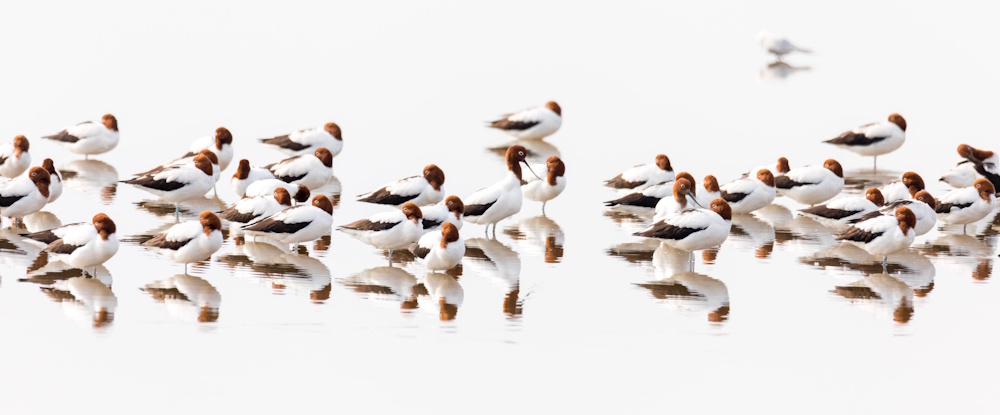
Red-necked avocets. Photo by Andrew Geschke.
A wetland of international importance
The Western Treatment Plant (WTP), on the western shore of Victoria’s Port Phillip Bay, is one of Australia’s most important wetlands for waterbirds. While its primary role is to treat around half of Melbourne’s wastewater, its vast network of lagoons, paddocks and coastal mudflats supports tens of thousands of waterbirds every year.The WTP provides vital habitat for many species, including migratory shorebirds that travel from the northern hemisphere to escape winter. During years of drought, it is also a refuge for waterbirds. As part of a Ramsar-listed wetland, the area is recognised internationally for its importance to bird communities.
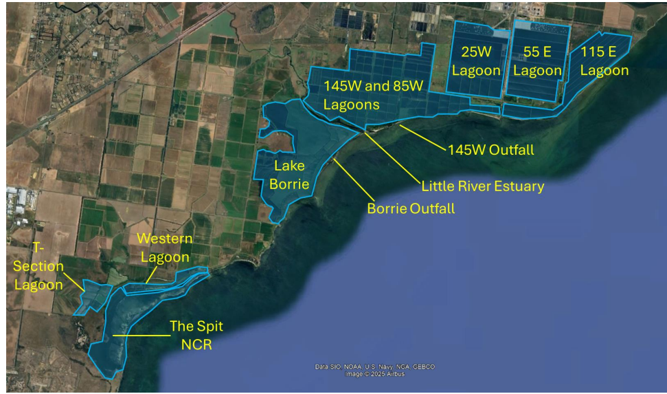
Map of the Western Treatment Plant showing major lagoon systems and Landmarks mentioned in the 2024-25 report.
What we are doing
Since 2000, ARI has led a comprehensive waterbird monitoring program with Melbourne Water to track waterbird numbers and understand their use of the WTP. This research is helping Melbourne Water to manage the conservation value of the wetlands and meet their obligations under State, Commonwealth and International laws.
Our surveys initially assessed the impacts of major treatment upgrades and land-use changes. It has since evolved into a study spanning almost three decades and is one of Australia’s most valuable long-term waterbird datasets.
Our research at the WTP helps to:
- Document which species are thriving, and which are declining
- Provide benchmark data to assess the effects of conservation management and future habitat changes
- Reveal how birds move between tidal flats, ponds, paddocks and inland wetlands
- Anticipate future pressures from sea-level rise and climate change
- Translate complex ecological patterns into practical, testable management actions.
Waterbird monitoring trends for 2000-2025
Encouraging trends
Red‑necked Stint, Sharp‑tailed Sandpiper, Pied Stilt and Australian Pied Oystercatcher have all increased over the long term at the WTP. Red‑necked Avocet numbers are currently stable after earlier growth.
Serious declines
Some shorebird species have declined throughout the East-Asian Australasian Flyway because of habitat destruction at stopover sites in Asia. This has impacted numbers of these shorebird species at the WTP. For example, Eastern Curlew now appears to be locally extinct at the WTP.
Curlew Sandpiper numbers have been stable for the last ten years or so, but they have not returned to their 1980s levels after decades of decline at the WTP and across the flyway.
Dynamic use of habitats
Preferred foraging sites change over time. During 2024-25, most shorebirds foraged on the tidal flats of The Spit Nature Conservation Reserve at low tide. At high tide, WTP shorebirds seem to prefer conservation ponds at the WTP, where they can roost, or do some top-up feeding if they didn’t find enough food at low tide.
At times of limited foraging opportunity in the conservation ponds, many WTP shorebirds roost on the barrier islands of the Spits Nature Reserve, or fly 10 to 15 km to the flooded salt-pans in the Avalon Coastal Reserve.
Climate-driven booms and busts
Waterfowl numbers at the WTP rise and fall with inland flooding and drought. After several wet La Niña years drew birds inland, 2024–25 saw higher duck numbers again at the WTP during a relatively dry year.
Long-term declines
Australasian Shoveler, Blue-billed Duck and Musk Duck. The causes of the declines are unknown but they are suspected to reflect Victoria-wide declines in these species, all of which are now listed as Vulnerable in Victoria.
Unexpected winter peaks
Pacific Black Duck and Grey Teal, usually most abundant in summer, have shown unusually high winter counts in recent years, suggesting changing movement or habitat patterns.
Ibis are still declining overall
Despite numbers during the 2024-2025 season being the highest in several years, yearly monitoring data since 2001 confirms a continuing long-term decline in Straw-necked Ibis using the WTP paddocks. This is consistent with the general population trends of large wading birds across eastern Australia. Irrigated grass is a key foraging habitat, and active management of a subset of paddocks is helping maximise habitat availability.
Valuable paddocks
Active management of conservation paddocks in the Terrestrial Margin area has increased the proportion of ibis foraging within this buffer zone over the long term. This demonstrates that targeted habitat management can shift bird use into conservation areas.
Brolga and other large waders
The WTP regularly supports notable numbers of large wading birds. At least 13 Brolga—listed as Endangered in Victoria—were recorded in a single count, and pairs have attempted breeding in the south‑west of the site.
Freshwater terns
The WTP holds spectacular numbers of Whiskered Terns in spring and early summer, often exceeding 5000 birds. Whiskered Tern numbers increased at the WTP in 2024–25, possibly due to the drying of inland wetlands after major flooding. Long-term models show no clear trend for Whiskered or White‑winged Black Terns, but highlight their sensitivity to inland conditions.
Fairy and Little Terns
The WTP-Avalon coast is now recognised as a major non‑breeding area for Fairy Tern. Autumn–winter counts can exceed 100 birds, accounting for up to two‑thirds of the estimated Victorian population. Little Tern numbers peak in summer, with a mix of Asian migrants and birds from the small south‑eastern Australian breeding population.
Cormorant breeding
The 25W Lagoon colony remains a key breeding site for Pied Cormorant. Recent monitoring shows consistent nesting between January and April, with occasional strong mid‑year breeding events that require a longer time series to understand better.
Publications
- Rogers et al. (2023) Use of non-tidal ponds by shorebirds at the Western Treatment Plant. Unpublished client report. (available upon request)
- ARI Technical Report 264 (2015) Literature Review: Management of Non-Tidal Ponds for Shorebirds (PDF, 0.8 MB) (DOCX, 2.7 MB)
- ARI Technical Report 256 (2014) Waterbird monitoring at the Western Treatment Plant 2000-12 (PDF, 4.6 MB) (DOCX, 4.8 MB))
Climate change and tidal flat management
Under forecasted climate change scenarios, sea-level rise is expected to significantly change the foreshore and low-lying areas of the WTP. In partnership with Melbourne Water, we investigated the possible impacts of sea-level rise on the WTP foraging areas and food resources for shorebirds and waterfowl.
Rising sea levels will impact shorebirds by reducing the area and shortening the duration of tidal flat exposure. To estimate this impact, we used a combination of foraging theory and empirical data on shorebirds and their prey, collected at the WTP over the past 20 years.
Key findings
- For shorebirds, the reduced duration of tidal flat exposure will have more of an impact than the decreased area of tidal flats.
- There is some capacity at the WTP for reduced tidal flat exposure time without loss of shorebirds. This is because of the high prey abundance on the tidal flats, and top-up feeding can be done in conservation ponds at high tide.
- Reduced foraging intake because of rising sea-levels is likely to first impact shorebirds during their period of pre-migratory mass gain (Feb-April), when their food requirements are highest. Prolonged periods of low air pressure and southerly winds are also challenging for migratory shorebirds at the WTP, as they result in limited tidal flat exposure.
We assessed how much each waterfowl species relies on the seaward ponds—prey‑rich, late‑stage treatment areas—to understand the potential impacts of losing these habitats to sea‑level rise.
Key findings:
- Losing the seaward row of treatment ponds to sea‑level rise would reduce the WTP’s pond surface area by 11%, displacing an estimated 4,000–14,000 waterbirds in summer that would need suitable habitat elsewhere.
- Carnivorous diving birds such as Musk Ducks are likely to be most affected by the loss of seaward ponds, because they depend on this deep, prey‑rich habitat that isn’t available elsewhere at the WTP.
Our research is supporting Melbourne Water’s Foreshore Adaptation Plan, allowing them to consider options such as coastal retreat, engineered foreshore works, increasing the carrying capacity and strategic creation or reconfiguration of ponds and tidal flats.
Publications
- ARI Report (2021). Potential impacts of sea-level rise on waterbirds at the Western Treatment Plant, Victoria (PDF, 2.1 MB) (DOCX, 4.4 MB) .
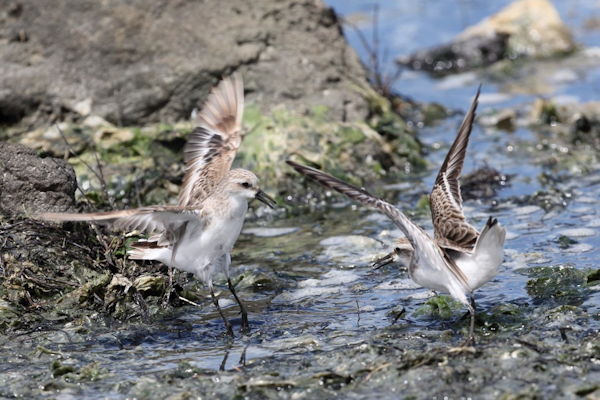
Territorial dispute - adult (left) and juvenile (right) Red-necked Stints, Beach Road - photo by Danny Rogers.
Nitrogen and waterbirds
Nitrogen plays a major role in supporting productivity in aquatic systems. While too much nutrient input can harm wetlands, moderate enrichment can help artificial wetlands (such as wastewater treatment plants) support large numbers of waterbirds.
Long-term research at Lake Borrie (2000–2020) examined how changing nutrient loads affected waterbird communities. Management of Lake Borrie provided a unique research opportunity, as the lagoon received different nutrient loads over this period: raw sewerage (2000-2005), treated sewerage effluent (2005-2015), and partially treated sewerage (2015-2020).
Our modelling found that waterfowl numbers increased with moderate levels of nutrients such as ammonia and nitrite. Species that feed on invertebrates, including filter-feeding ducks, diving ducks, Hoary-headed Grebes and marsh terns, showed the strongest responses. This work demonstrates that, with careful management, nutrient enrichment can boost waterbird abundance and diversity at treatment wetlands.
Publications:
- Loyn et al. (2023) Waterfowl populations decline with nutrient reduction and increase with nutrient restoration: 20 years of adaptive management at a Ramsar-listed wastewater treatment plant. Hydrobiologia.
- ARI Technical Report 250 (2013) Factors influencing tidal flats usage of shorebirds at the Western Treatment Plant (PDF, 2.8 MB) (DOCX, 3.6 MB)
For more information, contact Danny Rogers (danny.rogers@deeca.vic.gov.au).
You can learn more about ARI's research at the Western Treatment Plant through our ARI Seminar, featuring Danny Rogers speaking about the potential impacts of sea-level rise on migratory shorebirds at Victoria's Western Treatment Plant.
Page last updated: 15/09/26