In short
|
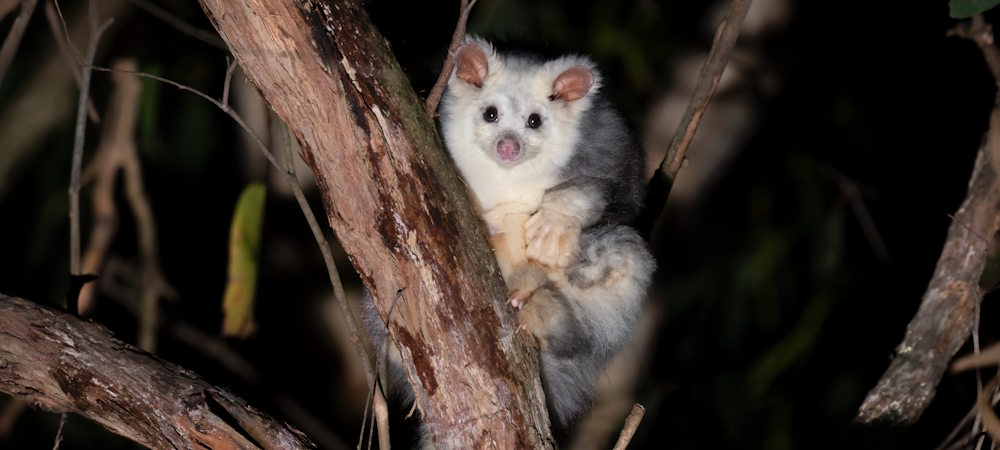
Southern Greater Glider (Petauroides volans). Photo by Justin Cally.
Southern Greater Gliders in Victoria
Southern Greater Gliders are the largest gliding marsupial in Australia and are found from northern NSW through to central Victoria. They feed exclusively on Eucalypt foliage, and in Victoria they prefer Manna Gum, Narrow-leaved Peppermint and Mountain Ash.
Southern Greater Gliders are dependent on tree hollows for shelter, nesting and protection. They do not make obvious sounds or calls, can glide up to 100m, and are very rarely seen on the ground. Southern Greater Gliders are also typically solitary, with home ranges of up to 4.4 hectares.
Southern Greater Gliders are listed as Endangered under the Environment Protection and Biodiversity Conservation Act 1999 and Victorian Flora and Fauna Guarantee Act 1988. They are threatened by the loss of suitable hollow-bearing trees and forest fragmentation through clearing and bushfires.
In Victoria, an estimated 32% of the Southern Greater Glider’s habitat was burnt during the 2019-2020 bushfires, and climate change may also be causing suitable habitats to contract. Habitat fragmentation may prevent populations from recolonising suitable areas and increase risk of genetic decline.
What we are doing
In 2017, ARI studied the relative accuracy of two survey methods in estimating Southern Greater Glider abundance. These surveys are particularly important for determining population sizes and evaluating the impacts of disturbances such as bushfires and storms.
Our researchers compared the double-observer spotlighting method with a traditional single-observer approach in the Strathbogie Ranges, to determine which approach provided more reliable estimates of Southern Greater Glider abundance.
The study found that the double-observer method could account for the species’ low detectability, resulting in more accurate population estimates. By contrast, relying on uncorrected counts from a single observer would significantly underestimate glider abundance.
The research also showed that Southern Greater Glider populations in the Strathbogie Ranges had remained more stable than populations in other parts of Victoria. Abundance was strongly influenced by habitat characteristics, particularly tree size and species.
Based on these findings, ARI adopted the double-observer spotlighting method as the standard for Southern Greater Glider surveys across Victoria. The approach has also been incorporated into survey guidelines used through the Forest Protection Survey Program.
Publications:
- Cripps et al. (2021). Double-observer distance sampling improves the accuracy of density estimates for a threatened arboreal mammal. Wildlife Research.
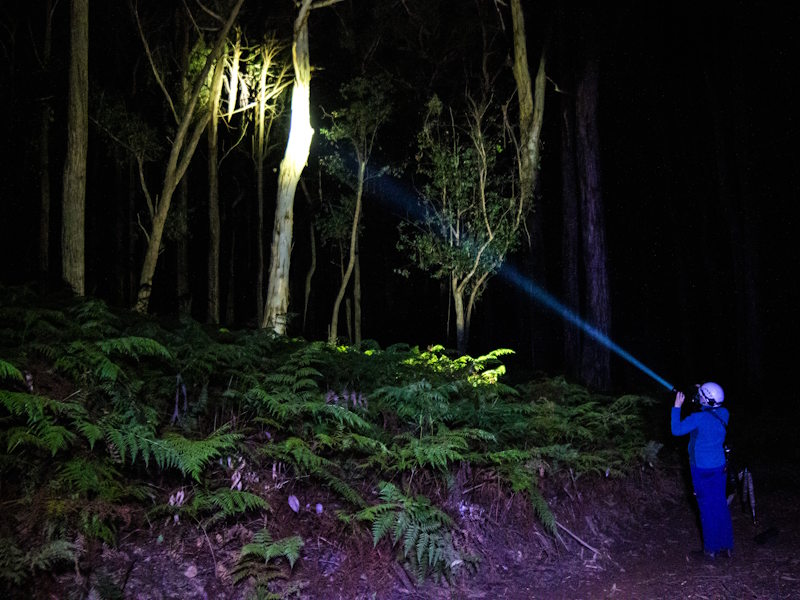
Surveying for arboreal mammals. Photo by Andrew Geschke.
ARI has surveyed for Southern Greater Gliders across their range in Victoria through various projects over the years. All observations are added to the Victorian Biodiversity Atlas (VBA), building Victoria’s biodiversity database and improving understanding of the species.
This has included:
- Landscape-scale surveys to estimate glider populations for updating the Victorian Regional Forest Agreements
- Forest Protection Surveys in timber coupes prior to harvesting, to determine glider occupancy and secure protection of habitats
- On-ground assessments to estimate populations of Southern Greater Gliders across the State.
These surveys have then been used to update the Habitat distribution models (HDMs), helping us to better understand where gliders can be found across Victoria.
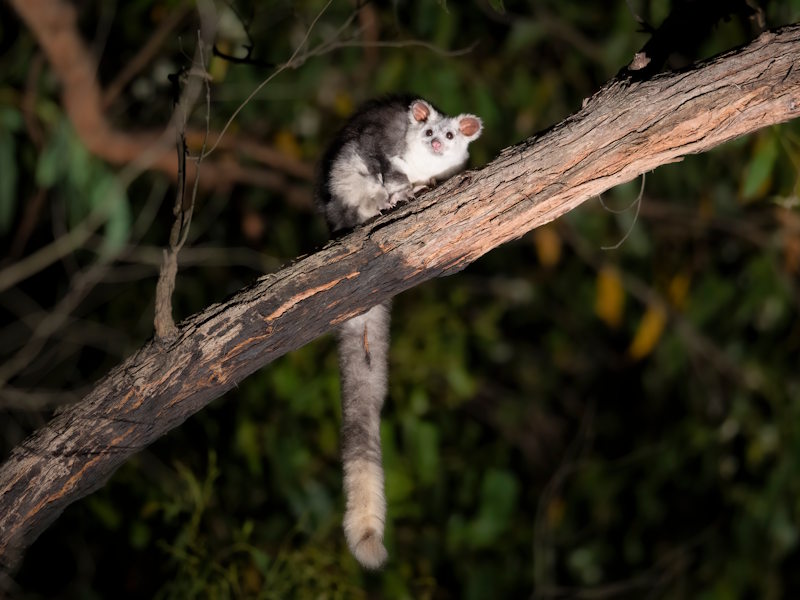
Southern Greater Glider. Photo by Justin Cally.
Following the 2019–2020 bushfires, which burned over 1.5 million hectares in Victoria, ARI surveyed for Southern Greater Gliders in East Gippsland to understand how the species responded to large-scale habitat loss.
Southern Greater Gliders rely on tree hollows for shelter and breeding and require an intact canopy for foraging (though they have been observed to occasionally eat epicormic growth after fire). The fires burnt around one-third of the species’ modelled habitat, with 16% impacted by high-severity fire.
Post-fire surveys conducted in East Gippsland during 2020–2021 sought to assess the persistence of Southern Greater Gliders in this region and identify areas of fire refugia – places where key habitat features such as canopy cover and hollow-bearing trees remained intact.
The species was rarely detected in severely burnt areas, and individuals were absent from nearly half of previously occupied sites, indicating a substantial decline in distribution and abundance.
The study also identified cooler, higher-elevation forests as important refuges, highlighting the critical role of intact habitat in supporting Southern Greater Glider recovery after major bushfires.
Publications:
Following the severe storm that struck central Victoria in 2021, ARI analysed survey data collected by double-observer spotlighting surveys across the Wombat State Forest. These data complemented surveys that had been conducted prior to the storm and were modelled using a mark-recapture distance sampling approach. This research indicated that Southern Greater Glider populations had declined substantially following the storm, with an estimated 39% reduction in abundance across the region.
The study also showed that Southern Greater Gliders had been most abundant in mature forests before the storm, and that areas with larger trees experienced relatively smaller population declines following the event.
These findings highlight the importance of protecting mature forest habitat to help Southern Greater Gliders withstand and recover from major disturbance events.
Publications:
- Cally et al. (2025). Mature forest habitat mitigates the decline of an endangered greater glider population through a widespread disturbance event. Forest Ecology and Management.
ARI is investigating how fire affects the survival of hollow-bearing trees, which provide essential habitat for Southern Greater Gliders and other hollow-dependent wildlife. Using long-term monitoring data collected in 2012 and resurveyed in 2020, the team is comparing tree collapse rates under three fire regimes: bushfires, planned burning, and areas with no fire.
The project is also examining the microclimates that occur inside tree hollows during planned burns. By installing temperature and air-quality sensors in hollows used by Southern Greater Gliders, researchers are measuring how burning may affect the animals occupying these shelters.
The findings will improve understanding of how fire influences both the persistence of hollow-bearing trees, and conditions in the hollows themselves, and will help inform fire management practices that better protect critical habitat.
ARI has developed Habitat Distribution Models (HDMs) for Southern Greater Gliders using advanced machine-learning techniques, to predict where suitable habitat occurs across Victoria. Verified records from the Victorian Biodiversity Atlas are combined with environmental information such as vegetation, climate and landscape features in the modelling framework.
We generated over 1,000 model variations, and in doing so filled data gaps that occur between real-world observations. This gives us a detailed picture of the species’ distribution beyond observed locations.
Southern Greater Glider HDMs are also incorporated into the ARI Integrated Biodiversity Values Model, which combines habitat models for many forest-dependent threatened species. This creates a comprehensive map of biodiversity values across Victoria, helping guide conservation planning and identifying high value native forest areas.
This work has been supported by the Victorian Government through a range of programs, including funding to assess the impacts of the 2019–20 bushfires through the Biodiversity On-ground Actions Initiative – Urgent Actions Fund.
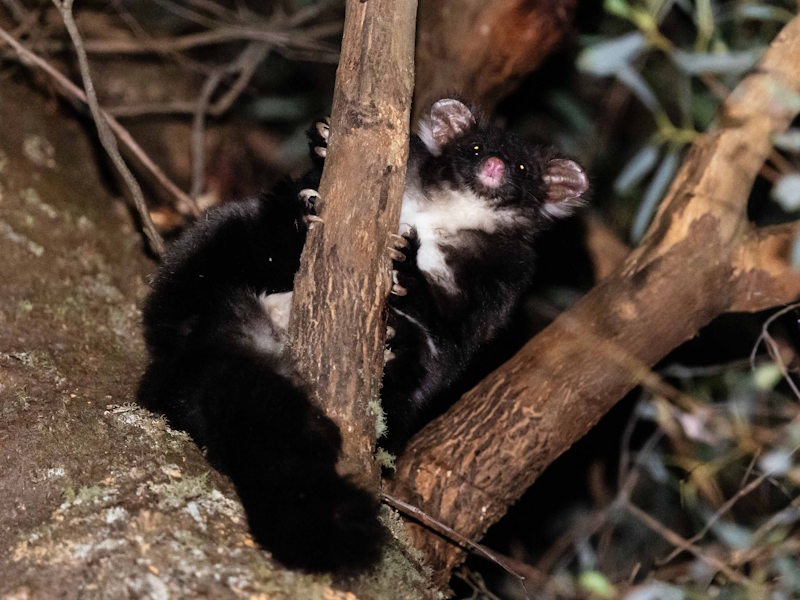
Southern Greater Glider. Photo by Andrew Geschke.
More information
Publications
- Cally et al. (2025). Mature forest habitat mitigates the decline of an endangered greater glider population through a widespread disturbance event. Forest Ecology and Management.
- ARI Fact sheet (2023) Assessment of the 2019–2020 fires on the Southern Greater Glider and Yellow-bellied Glider.
- Cripps et al. (2021). Double-observer distance sampling improves the accuracy of density estimates for a threatened arboreal mammal. Wildlife Research.
- ARI Technical Report 293 (2018). Estimating the density of the Greater Glider in the Strathbogie Ranges, North East Victoria, with an assessment of coupes scheduled for timber harvesting in 2018.
For more information on Southern Greater Glider research at ARI, contact Dr Jemma Cripps (jemma.cripps@deeca.vic.gov.au).
Page last updated: 15/09/26