In short
|
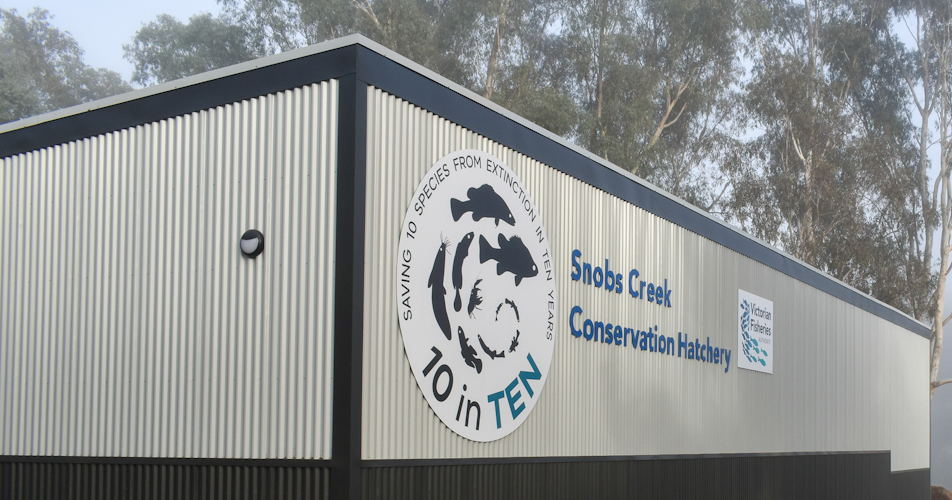
10inTen Conservation Hatchery Building, Snobs Creek
Captive breeding to protect species from extinction
Victoria is home to incredibly diverse freshwater animals that are of both ecological, cultural and recreational significance. Our most vulnerable freshwater animals only exist in small, fragmented and narrow distributions, and single extreme events such as bushfires, droughts and floods could cause their extinction.
More than 30 freshwater fish and 20 crayfish species are recognised as threatened under the Flora and Fauna Guarantee Act 1988. Many of these species are also recognised as threatened Nationally, under the Environment Protection and Biodiversity Conservation Act 1999.
Captive breeding of our threatened freshwater species is an essential part of future conservation efforts to prevent extinction. It will help species recover from extreme events (such as bushfires, droughts and floods) and complement broader river and wetland rehabilitation efforts.
10inTen – an ambitous goal for threatened aquatic species
In May 2024, Victoria’s Conservation Hatchery was opened at the VFA’s Snobs Creek Hatchery to captively breed at least 10 threatened species in the next 10 years.
This new facility enables scientists, Traditional Owners and industry to work together to:
- select species
- plan breeding and release programs
- improve population genetic diversity
- undertake community education.
The 10inTen program means Victoria will be better placed to deal with extreme events by spreading the risk, strengthening genetics, creating ‘insurance’ populations, and stocking for conservation purposes.
10inTen contributes to an integrated approach to fish recovery where multiple interventions are needed, including providing environmental flows and rehabilitating and protecting their habitats.
10inTen is a collaboration between ARI, the Victorian Fisheries Authority (VFA), and many Traditional Owners, catchment management authorities and interest groups. Linking in with relevant plans and strategies at state and national scales is helping achieve multiple goals within a single program.
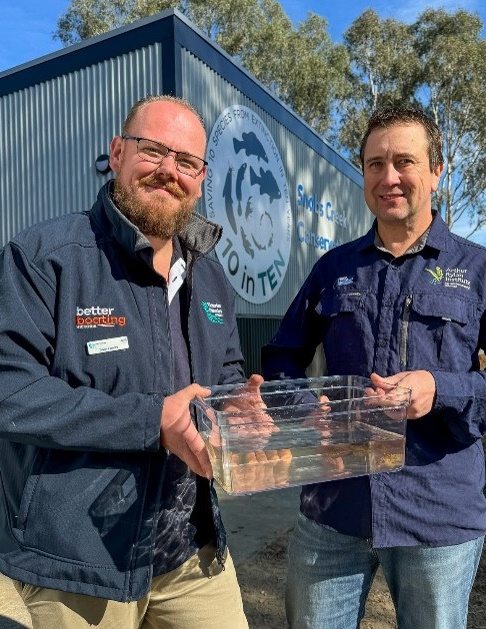
Sam Fawke, VFA and Jarod Lyon ARI with Murray Spiny Craylings at the Conservation Hatchery (Photo: DEECA)
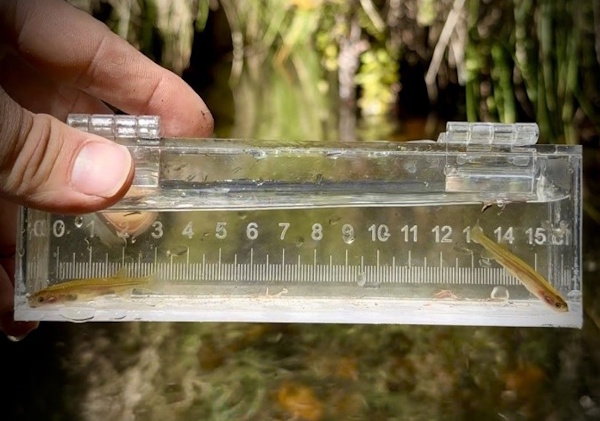
Releasing Moroka Galaxias (Photo: VFA)
What we are doing
The working relationship between ARI and the VFA is integral to the success of 10inTen. ARI is involved in species’ selection, collection of broodstock, selection of release sites and subsequent population monitoring.
VFA brings a wealth of expertise to the maintenance, rearing and release of aquatic species and engagement of recreational anglers.
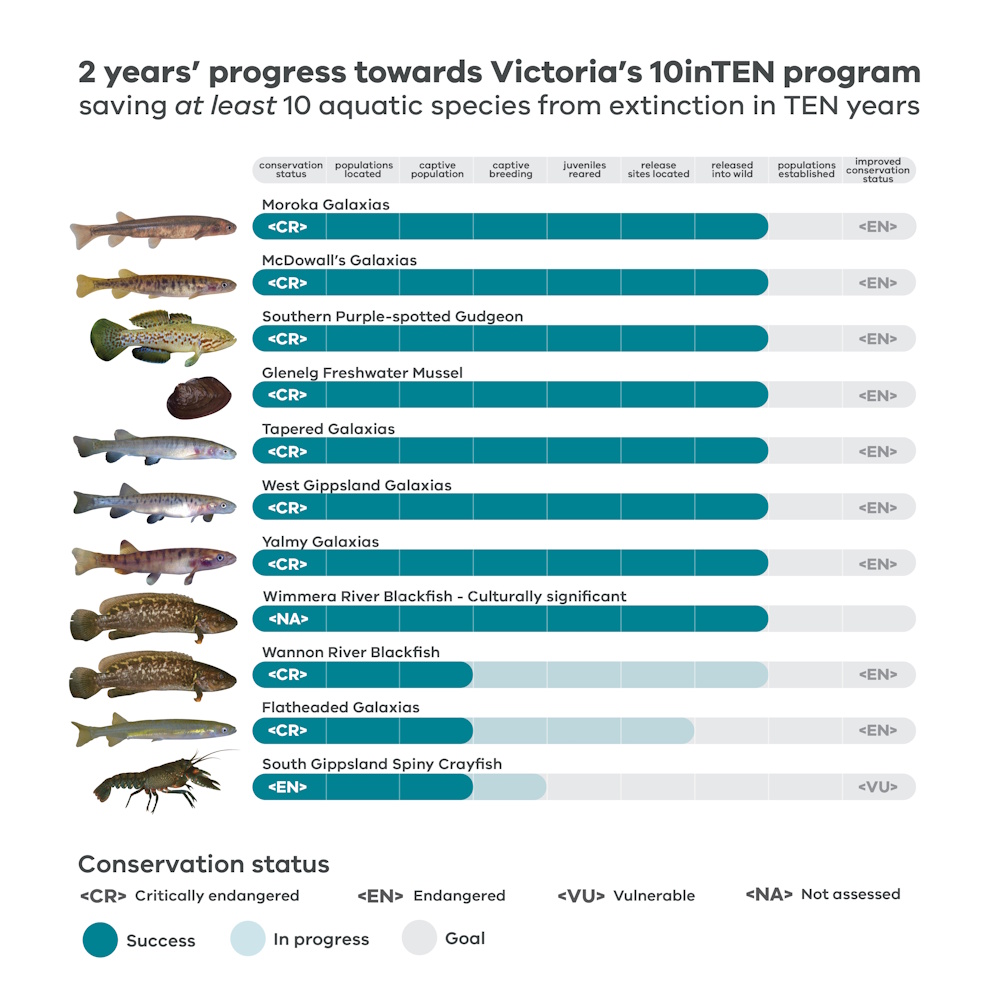
Progress towards species recovery for aquatic species supported by 10inTen as of June 2026
- Two nationally Critically Endangered fish species (McDowall’s Galaxias and Yalmy Galaxias) were successfully bred at the hatchery and released in East Gippsland.
- Three nationally Critically Endangered fish species (Moroka Galaxias, Tapered Galaxias and West Gippsland Galaxias) were successfully bred at the hatchery and released in West Gippsland.
- The nationally Critically Endangered Glenelg Freshwater Mussel has been bred at the hatchery and released in the Crawford River.
- The Victorian Critically Endangered Southern Purple-spotted Gudgeon has been bred and released at multiple sites across Victoria.
- The culturally significant Wimmera River Blackfish was successfully bred and released at three sites in the Grampians area.
- Some of the nationally Critically Endangered Wannon Blackfish were collected following the Grampians fires, with fish translocated to dams and taken to the hatchery. Breeding trials are planned.
- The nationally Critically Endangered Flathead Galaxias are in the hatchery, and breeding trials are planned.
- The nationally Vulnerable Murray Spiny Crayfish was successfully reared at the hatchery and released in the lower Goulburn and Little Murray rivers.
- The nationally Endangered South Gippsland Spiny Crayfish and Victorian Endangered Narracan Freshwater Mussel have been collected from the wild and are adapting to hatchery conditions in readiness for breeding trials.
- VFA stocks Macquarie Perch into rivers and lakes in Victoria. The “Crack the Code” program is focused on improving breeding success. A new Macquarie Perch Recovery Centre at Snobs Creek will increase the number of fish produced. River rehabilitation efforts in many northern Victorian rivers are also enhancing natural recruitment.
- VFA stocks Trout Cod into north east Victorian rivers and the Goulburn River system. River rehabilitation efforts in many northern Victorian rivers are also enhancing natural recruitment.
In the first two years after opening, significant progress has been made through the Conservation Hatchery, which includes:
You can find out more about each species progress in the 10inTen Species progress flyer - May 2026 (PDF, 4.2 MB) (DOCX, 37 KB).
The 10inTen collaboration has also contributed to multiple rescues of Blackfish, crayfish species and Flathead Galaxias in support of flood and fire responses, as well as the return of the Olive Perchlet to Victoria (a species previously believed extinct).
Whilst called 10inTen, there are in fact about 27 species with potential to be bred at the hatchery or at the Arcadia Hatchery, which have conservation and cultural significance. This includes large-bodied native species such as Freshwater Catfish and Macquarie Perch.
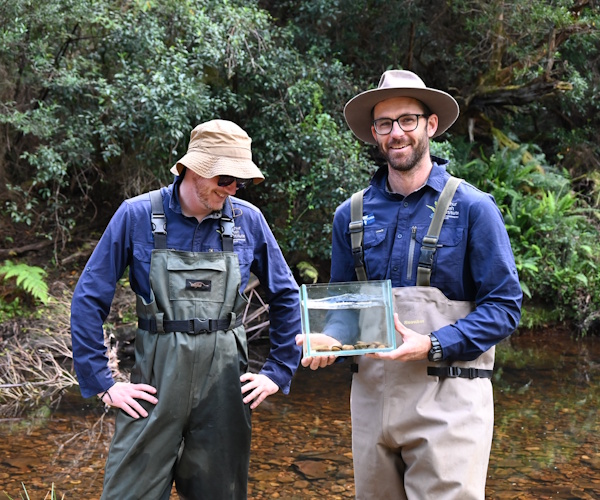
ARI staff about to release Moroka Galaxias (Photo: ARI)
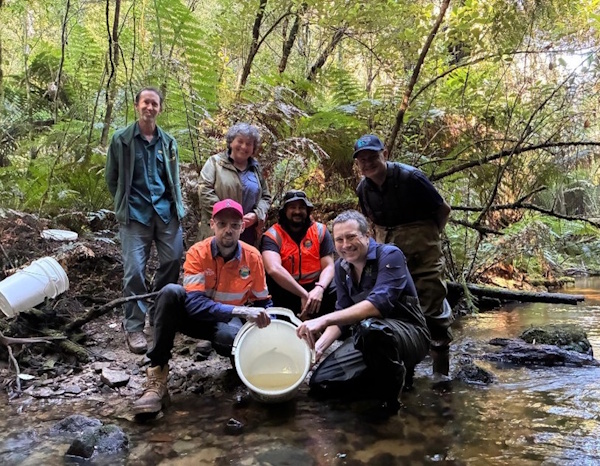
Release of West Gippsland Galaxias, with Gunaikurnai Land and Waters Aboriginal Corporation, Middle Creek Farm, Forest Fire Management Victoria, ARI and VFA (Photo: VFA)
The 10inTen collaboration has also contributed to multiple rescues of Blackfish, crayfish species and Flathead Galaxias in support of flood and fire responses, as well as the return of the Olive Perchlet to Victoria (a species previously believed extinct).
Whilst called 10inTen, there are in fact about 27 species with potential to be bred at the hatchery or at the Arcadia Hatchery, which have conservation and cultural significance. This includes large-bodied native species such as Freshwater Catfish and Macquarie Perch.
Acknowledgements
This project has been funded by contributions from Victorian and Commonwealth governments, including DEECA, the Victorian Environmental Water Holder (VEWH), the Commonwealth Department of Climate Change, Energy, the Environment and Water (DCCEEW) and through Disaster Recovery Funding Arrangements and the Saving Native Species Program.
More information
For further information contact, Jarod Lyon (Jarod.Lyon@deeca.vic.gov.au). You can also view the extended project video 10inTen - Recovering Victoria’s Most Threatened Aquatic Species, or visit our partner's webpage, Conservation Hatchery – VFA.
Page last updated: 02/06/26